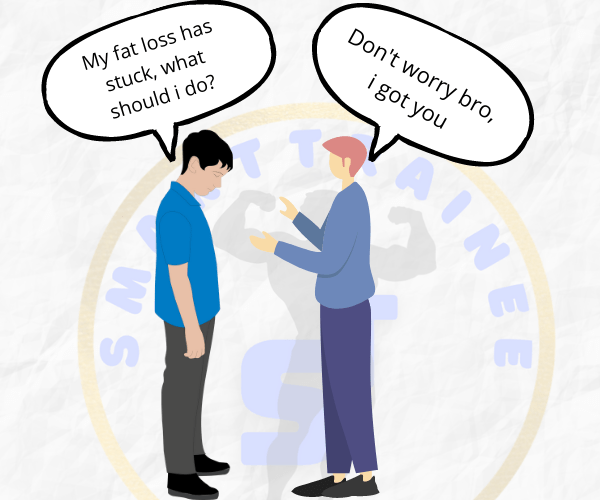
Remember the moment you started losing fat, everything was going smoothly in the right direction – you were noticing progress, you’ve been losing fat but after sometime everything stagnated. Suddenly, your fat loss progress stuck – you’re eating in calorie deficit, you’re training regularly but you aren’t able to see the progress you once were. Everything stagnated and you’re flummoxed.
WHAT HAPPENED?
Well, this situation is called hitting the fat loss plateau. We all have been there at least once in our crusade for fat loss.
FAT LOSS PLATEAU
Scientifically, it is a situation where your body halt losing weight further regardless of the fact that you’re still eating in a calorie deficit.
What Causes Plateau?
During first few weeks of losing weight, a rapid drop in weight is normal. In a nutshell, this is because when you cut calories, the body gets needed energy initially by releasing it’s stores of glycogen, a type of carbohydrate found in muscles and liver.
As you lose weight, you lose some muscle along with fat. Muscle helps keep the rate at which you burn calories(metabolism) up.
So, as you lose weight, your metabolism declines, causing you to burn fewer calories than you did at your heavier weight.
The slower metabolism will slow your weight loss, even if you eat the same number of calories that helped you lose weight. When the calories you burn equals the calories you eat, you reach a plateau.
How to cope with it?
Plateaus, unfortunately are intractable. It’s impossible to say “if you do X, it will break your plateau”. However, there are some general things you can look at that will aid put you in the right direction.
Coping Methods:
Cut more calories
Further reduce your daily calorie intake, provided this doesn’t put you below 1400 calories deficit. Deficit of more than 1400 calories a day may not be enough to keep you from constant hunger and it will also eventuate in deprivation of vital micro and macro nutrients, which can wreck your overall health.
Pack more activity into your day
Reckon outside the gym. Increase your general physical activity throughout the day by walking more and using your car less, or try doing more vigorous physical activities. This will help you burn more calories.
Diet Breaks
Are you already eating in extreme deficit(<1400 calories deficit) and can’t reduce your deficit further? What to do in this situation? Well, take a diet break buddy.
Diet break is a period of time when you eat at your maintenance calories. It works as an energy booster and will keep you motivated to pursue your fat loss goal.
Several researches found that people who take diet breaks in between their fat loss goal have more adherence to their goal than those who don’t.
Different ways to take diet breaks:
- If you’re eating in a deficit from too long (>1-2 months), then you can have a week or two diet break in which you’ll consume calories equivalent to your maintenance calories.
- You can also have short diet breaks like for instance, you eat in a calorie deficit for 2 weeks and then for next 1 week, you’ll take a diet break.
- You can also have a diet break once a week. Suppose for 6 days, you’re eating in a deficit and on 7th day, you took a diet break to enjoy your favorite food. If you’re foody like me, this method is befitting for you.
CAVEAT:
Don’t confuse diet breaks with cheat days. Cheat day means you’re eating everything you got on your table mindlessly without tracking your calorie intake, this is not at all conducive to your goals.
On the other hand, diet breaks meaning eating at you maintenance calories mindfully while still tracking your calorie intake.
DONE.
That’s all about today’ blog. See you all in my next blog, Till then stay healthy, keep exercising and be considerate towards others.
If you adulate my content, make sure to follow my blog for knowledge bombs.
 Fitness Aficionado